

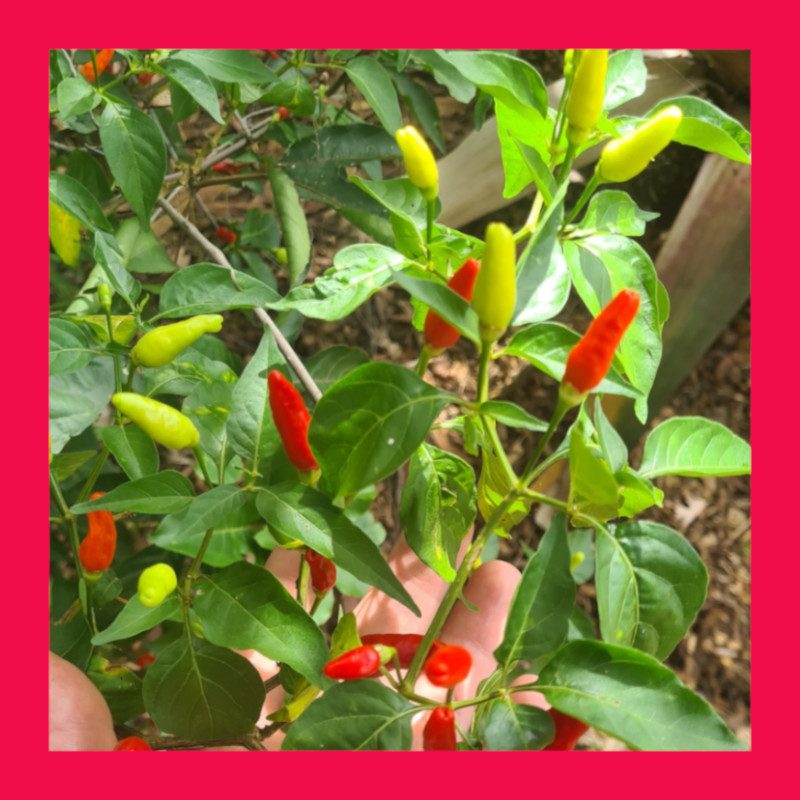
CHILLI-BAHAMIAN BIRD
$3.60
Shipping and taxes calculated at checkout
Seeds per pack:
15
Capsicum Annuum
CHILLI-BAHAMIAN BIRD Originally hailing from the Bahamas this clumping chili with its slender finger like appearance can grow up to 6 centimeters long on a bush which can grow to over 91cm (3 feet). With a heat factor somewhere between Cayenne and Habanero of 95,000-110,000 it is best used in cooking rather than eating raw due to the heat factor though I personally find it a good mild chilli with a mild flavour. It can become a large very productive bushy plant with different coloured fruit, surviving from 3 to 5 years and keeps on giving each season if not hit by a heavy frost.
Plant in well drained fertile soil, water deeply with compost juice once a week for the first 6 weeks and mulch around the tree. They like warm soil to germinate and can take anywhere from 1 week to a month to germinate.
Remember to protect your chilli plants from pests such as aphids, spider mites, and whiteflies. You can control them with insecticidal soap, neem oil or organic insecticides. Additionally, watch out for fungal diseases such as powdery mildew and root rot. Avoid overwatering and provide good air circulation to prevent these diseases. Warm humid environments can be accomplished in a greenhouse where you can control the temperatures
SKU: CIBB
- Fast Australia-wide dispatch
- Secure checkout
- 30-day money-back guarantee
How to Grow Bahamian Bird Chilli
To grow Bahamian bird chilli peppers, you will need to follow these general rules:- Choose a location with full sun exposure (at least 6 hours), and well-draining soil, rich in organic matter. (chilli's are heavy feeders). Bahamian bird chilli peppers prefer warm weather and a temperature range between 25-35 °C.
- Start the seeds indoors in seed trays or pots, 6-8 weeks before the last frost. Keep the soil consistently moist and warm until germination, which typically takes 7-14 days.
- Transplant the seedlings into the garden or into larger pots when they have at least 2-3 leaves and have grown to about 15 cm tall. Space them about 30-45 cm apart.
- Water the plants regularly, keeping the soil consistently moist but not waterlogged.
- Fertilise the plants every 4-6 weeks with a balanced fertiliser, such as a 10-10-10 or 20-20-20 mixture.
- Provide support for the plants, such as a trellis or stake, as they grow taller.
- Pinch back the growing tips of the plant to encourage bushier growth and more fruit production. You can also remove any damaged or diseased leaves to prevent the spread of disease.
- Harvest the chilli peppers when they are fully ripe, which is typically when they turn red or yellow.
Heritage of Bahamian Chilli
Bahamian chilli is a spicy condiment that is popular in the Bahamas, particularly on the island of Eleuthera. The heritage of Bahamian chilli can be traced back to the African slaves who were brought to the Bahamas by European colonisers in the 18th and 19th centuries. These slaves brought with them their own culinary traditions, which included the use of spices and peppers to flavour their food. Over time, Bahamian chilli evolved into its own unique recipe, incorporating local ingredients such as lime juice, vinegar, and various Caribbean peppers. Today, there are many variations of Bahamian chilli, each with its own unique combination of spices and peppers. Bahamian chilli is often used as a condiment for seafood, such as conch fritters or fish sandwiches. It is also used to flavour stews and other dishes. The spicy, tangy flavour of Bahamian chilli is a popular part of the Bahamian culinary heritage and is enjoyed by locals and tourists alike.| Scoville Heat Units (SHU) | 95,000-110,000 |
|---|---|
| Plant Height | 45 - 91cm (1'6" - 2'12") |
| Season of Interest | warm to hot |
| Temperature Range | 31 - 32°C (88 - 90°F) |
| Annual / Perennial / Biennial | Perennial / Annual |
| Frost Hardy / Tender | Tender |
| Sun Exposure | Full sun |
| Sow Direct / Raise Seedlings | Either |
| Soil Type | Sandy Loam, Rich in nutrients. added compost to the soil for fertility, and dolomite or crushed egg shells to help fend off blossom end rot |
| Soil pH | 6.3 - 6.5 |
| Soil Temperature | 18 - 30°C (64 - 86°F) |
| Seed Preparation | Soak seeds overnight in lukewarm water or freeze for a few days before planting |
| Sowing Depth | 5mm (¼") |
| Plant Spacing | 30 - 45cm (1⅛" - 1'6") |
| Row Spacing | 110 - 150cm (3'7" - 4'11") |
| Watering | regular watering required, keep moist but not wet. |
| Germination Time (Days) | 7 - 30 |
| Harvest Time (Days) | 130 |
| Good Companion Plants | Carrots, cucumber, squash, members of the Allum family, Basil, Dill, Fennel |
| Bad Companion Plants | Kohlrabi. cabbage, broccoli, cauliflower, and mustards |
| Pests | Aphids, Whiteflies, Thrips, Flea Beetles, Cabbage Loopers, Leaf Miners,Flea Beetles, Pepper Weevils, Leaf Miners, Caterpillar |
| Diseases | blossom end rot |
| Not shipped to Tasmania | true |
| Seeds per pack | 15 |
| Min temperature (C) | 31 |
| Max temperature (C) | 32 |

CHILLI-BAHAMIAN BIRD
$3.60

More About Direct Compost Solutions
When I started this journey in 2009, I found nothing existed commercially, that was reasonably priced and easy to use. There was a homemade system which I also found was not that user-friendly.
Then a friend of mine told me about a homemade method she used. However, when I tried her method, I found this also didn't suit my needs, as it too had flaws that I considered where important. It did not keep vermin out, did not have a lockable lid and (to me) looked unsightly in the garden.
