

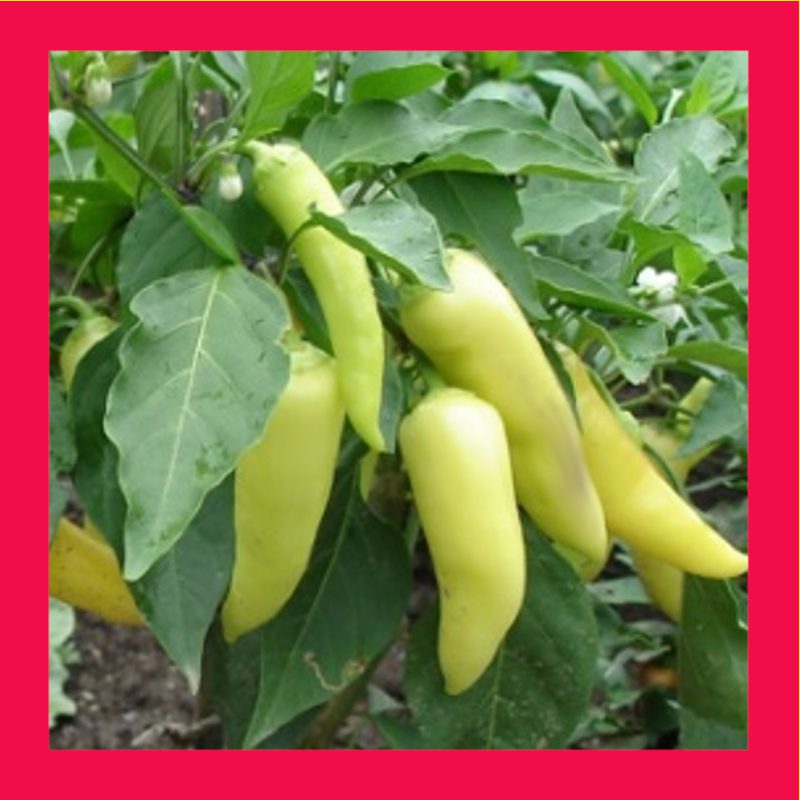
CHILLI-BANANA
$3.60
Shipping and taxes calculated at checkout
Seeds per pack:
10
Capsicum annuum
CHILLI-BANANA is a long yellow very mild chilli with an SKU of only 500. It is said to have originated initially from Hungary, though most information suggests it came from South America.
SKU: CIB
- Fast Australia-wide dispatch
- Secure checkout
- 30-day money-back guarantee
It was developed into the bananas chilli of today in America in 1940 by the Corneli Seed Company. Similar in looks to Hungarian Yellow Hot Wax but is very different in heat content. I changes colour as it matures and is generally harvested when it has just turned yellow to get the sweetest fruit. Think flesh with a waxy skin, it grows to roughly 20cm long with a curve at the end resembling a banana - hence the name.
Banana chilli can be eaten raw, pickled, baked or stuffed. Add it to salads, pizza, sandwiches or whatever takes your fancy to spice up dish with a bit of tang without overdoing the heat. Nutritionally the banana tree chilli contains many vitamins and minerals but is particularly high in Vitamin C.
Raise seedling indoor before the end of winter and plant out in early Spring after the last frost if you live in a cool climate. Warmer climates are not so restrictive in time to plant and can be grown as a perennial from seed if winters are mild. Trim off first flowers and fruit to increase production. Freezing chilli seeds for a few days before planting tricks the seed into thinking it has just come through winter and needs to sprout. Or soak seed for 12 to 48 hours if the seed is difficult to germinate.
Prepare you soil with well matured manure before planting out. Water deeply and often. Fertilise with a nitrogen rich foliar spray in the first few weeks. Harden off before planting out.
Buy ABSeeds
http://era.daf.qld.gov.au/id/eprint/1651/5/4keycap.pdf
There is a huge amount of information on this link.
Just scroll through the stuff that does not interest you.
But well worth the read if you are into growing chillies.
| Scoville Heat Units (SHU) | 0- 500 |
|---|---|
| Plant Height | 30 - 60cm (1⅛" - 1'12") |
| Season of Interest | warm to hot |
| Temperature Range | 22 - 30°C (72 - 86°F) |
| Annual / Perennial / Biennial | Perenial/Annual |
| Frost Hardy / Tender | Tender |
| Sun Exposure | Full sun |
| Sow Direct / Raise Seedlings | Either |
| Soil Type | Sandy Loam, Rich in nutrients. added compost to the soil for fertility, and dolomite or crushed egg shells to help fend off blossom end rot |
| Soil pH | 6 - 7 |
| Soil Temperature | 16 - 25°C (61 - 77°F) |
| Seed Preparation | Soak seeds overnight in lukewarm water or freeze for a few days before planting |
| Sowing Depth | 5mm (¼") |
| Plant Spacing | 30 - 40cm (1⅛" - 1'4") |
| Row Spacing | 45 - 70cm (1'6" - 2'4") |
| Watering | regular, keep moist NOT wet |
| Germination Time (Days) | 4 - 20 |
| Harvest Time (Days) | 60 - 75 |
| Good Companion Plants | Carrots, cucumber, squash, members of the Allum family, Basil, Dill, Fennel |
| Diseases | blossom end rot |
| Not shipped to Tasmania | true |
| Seeds per pack | 10 |
| Min temperature (C) | 22 |
| Max temperature (C) | 30 |

CHILLI-BANANA
$3.60

More About Direct Compost Solutions
When I started this journey in 2009, I found nothing existed commercially, that was reasonably priced and easy to use. There was a homemade system which I also found was not that user-friendly.
Then a friend of mine told me about a homemade method she used. However, when I tried her method, I found this also didn't suit my needs, as it too had flaws that I considered where important. It did not keep vermin out, did not have a lockable lid and (to me) looked unsightly in the garden.
