

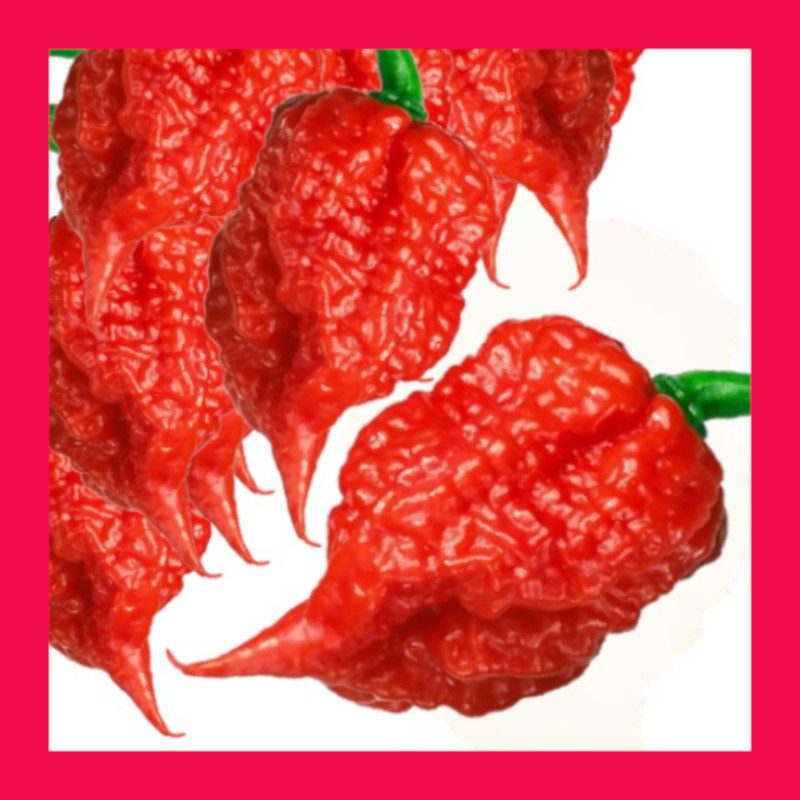
CHILLI-CAROLINA REAPER
$3.60
Shipping and taxes calculated at checkout
Seeds per pack:
11
Capsicum Chinense
CHILLI-CAROLINA REAPER is regarded as the hottest chili in the world. It was developed by a man known as Ed Currie by crossing Pakistani Naga with Red Habanero. Carolina Reaper Chilli has an SHU rating of 1,400,00 to 2,200,00 it is listed in the Guinness Book of records as the hottest pepper in the world.
Smallish pods are vibrant red, 2.5 to 5cm wide, 5 – 7.6cm long with a little scorpion like tail and smooth or lumpy textured skin. It is said to have a sweet fruity flavour if you are brave enough to eat them. Plus, they make an excellent dried spice to add to any meal, sauce, stew or soup.
Start indoors 8-10 weeks before the last frost in well drained light soil. Depth 3-6mm gently covered with light soil. Germinates 7-10 days plus. Plant out when temperatures are above 10°C. They can take up to 90 days before they are ready to fruit. Don't overwater or over fertilise with nitrogen or you will have no fruit. Plant out 75cm apart when seedling reaches 7 – 10cm in height.
Like all chillies watch for pests and diseases that affect chillies.
SKU: CICR
- Fast Australia-wide dispatch
- Secure checkout
- 30-day money-back guarantee
How to Grow Carolina Reaper Chilli
Follow this basic guide to grow Carolina Reaper Chilli- Choose a location with full sun exposure and well-draining soil. Carolina Reaper chilli peppers prefer warm weather and a temperature range between 20-30 °C.
- Start the seeds indoors in seed trays or pots, 6-8 weeks before the last frost. Keep the soil consistently moist and warm until germination, which typically takes 7-14 days.
- Transplant the seedlings into the garden or into larger pots when they have at least 2-3 leaves and have grown to about 15 cm tall. Space them about 30-45 cm apart.
- Water the plants regularly, keeping the soil consistently moist but not waterlogged.
- Fertilise the plants every 4-6 weeks with a balanced fertiliser, such as a 10-10-10 or 20-20-20 mixture.
- Provide support for the plants, such as a trellis or stake, as they grow taller.
- Harvest the chilli peppers when they are fully ripe, which is typically when they turn red.
Heritage of Carolina Reaper Chilli
The Carolina Reaper Chilli was developed by Ed Currie in Rock Hill, South Carolina, USA. It was officially recognized as the world's hottest pepper by the Guinness World Records in 2013, with an average Scoville rating of 1.5 million units. The pepper is a crossbreed between a Pakistani Naga and a Red Habanero. These chilies should be handled with care, as the heat level is extremely high and it is important to wear gloves and be cautious when consuming them. An unusual fact about the Carolina Reaper is it's unique shape, with a distinct "scorpion tail" at the bottom of the pepper. The shape was apparently, intentionally bred into the pepper by its creator, Ed Currie. This was in order to make it visually distinctive to stand out in the marketplace. Additionally, Chilli-Carolina Reaper is so hot it can actually cause physical pain when consumed. And could lead to serious health complications if eaten in excessive amounts. Is is said that the pain in your mouth can last for 20 minutes while the intestinal pain can last for up to 5 hours. It is not a chilli to be taken lightly. Be sure to wear gloves when handling it and don't rub your eyes if you happen to handle it without gloves.| Scoville Heat Units (SHU) | 1,400,000 - 2,200,000 |
|---|---|
| Plant Height | 60 - 120cm (1'12" - 3'11") |
| Season of Interest | Summer |
| Temperature Range | 20 - 30°C (68 - 86°F) |
| Annual / Perennial / Biennial | Perennial /Annual |
| Frost Hardy / Tender | Tender |
| Sun Exposure | Full sun |
| Sow Direct / Raise Seedlings | Either |
| Soil Type | Sandy Loam, Rich in nutrients. added compost to the soil for fertility, and dolomite or crushed egg shells to help fend off blossom end rot |
| Soil pH | 6 – 6.5 |
| Soil Temperature | 26 - 29°C (79 - 84°F) |
| Seed Preparation | Soak seeds overnight in lukewarm water or freeze for a few days before planting |
| Sowing Depth | 0.1 - 5.0mm (⅛ - ¼") |
| Plant Spacing | 60 - 90cm (1'12" - 2'11") |
| Row Spacing | 90 - 120cm (2'11" - 3'11") |
| Watering | regular, keep moist don't overwater |
| Germination Time (Days) | 7 - 10 days or more |
| Harvest Time (Days) | 100 - 150 (when red) |
| Good Companion Plants | basil, oregano, chives, dill, rosemary, thyme, petunias, geraniums, marigolds, and nasturtium |
| Bad Companion Plants | Kohlrabi, peas, beans, beetroot, Fennel, and fruit tree |
| Pests | Aphids, Whiteflies, Thrips, Flea Beetles, Cabbage Loopers, Leaf Miners,Flea Beetles, Pepper Weevils, Leaf Miners, Caterpillar |
| Diseases | Mosaic Virus spread by Aphids and Whitefly, Powdery Mildew, Fusarium Wilt, Bacterial Wilt, Rhizoctonia Rot, Damping Off, Late Blight, Anthracnose, |
| Not shipped to Tasmania | true |
| Seeds per pack | 11 |
| Min temperature (C) | 20 |
| Max temperature (C) | 30 |

CHILLI-CAROLINA REAPER
$3.60

More About Direct Compost Solutions
When I started this journey in 2009, I found nothing existed commercially, that was reasonably priced and easy to use. There was a homemade system which I also found was not that user-friendly.
Then a friend of mine told me about a homemade method she used. However, when I tried her method, I found this also didn't suit my needs, as it too had flaws that I considered where important. It did not keep vermin out, did not have a lockable lid and (to me) looked unsightly in the garden.
