

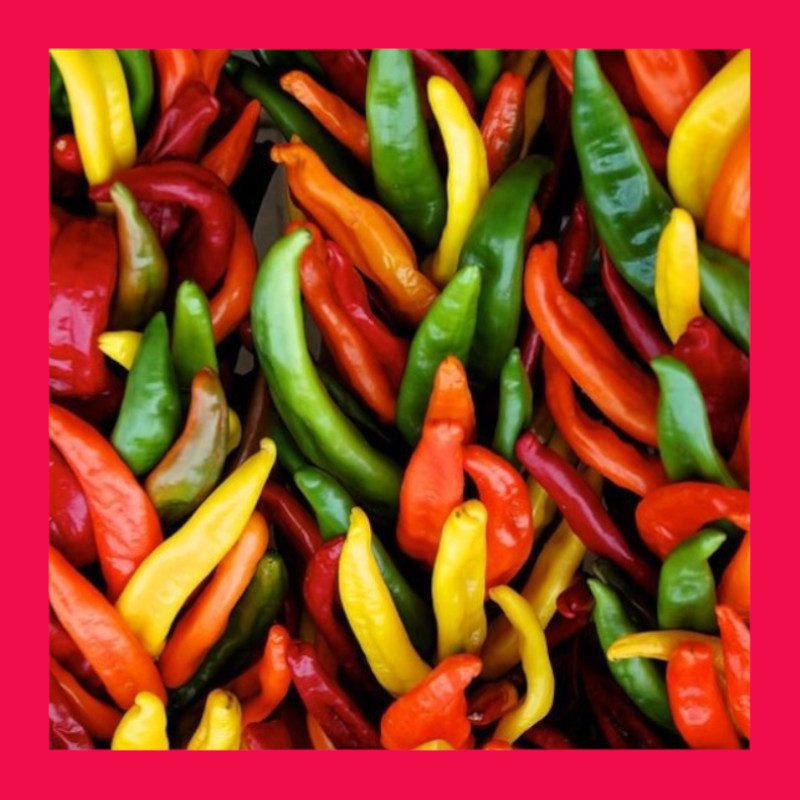
CHILLI-CAYENNE MIX
$3.60
Shipping and taxes calculated at checkout
Seeds per pack:
17
Capsicum annuum
CHILLI-CAYENNE MIX are multicoloured thin chillies that are roughly 7cm long originating from Cayenne, French Guiana in South America.
Red cayenne chilli's are often dried, ground and sold as cayenne pepper. Heat and flavour varies depending on when they were picked and what colour they were when picked. From the same family as Jalapenos (Solanaceae) they are 10 times hotter than Jalapenos.
Cayenne Mix Chilli's are suitable for drying, freezing or bottling in oil. Eat chopped or diced with soups, casseroles, salsa, Mexican dishes and more.
They need a warm to hot climate to grow, but not too hot or cold, therefore good for temperate and tropical climates. If night time temps are above 23C or below 15 C your chilli's will suffer. In cooler climates you need to start cayenne mix chilli's indoors and plant out when soil temperature is warm enough.
Use slightly acidic soil that is well drained, with added compost and water well but do not overwater. Grow in a nice sunny position, keep weeds at bay with a mulch covering but not one that in rich in Nitrogen such as grass clippings, or you chilli's might not fruit.
Generally easy to grow and save seeds.
Note: Cayenne Mix peppers typically take about 60-70 days to mature. These chilies are considered to have a medium heat level, with a Scoville rating of around 30,000-50,000. They are great for adding flavour and heat to many different dishes.
It's important to note that the growing requirements and characteristics of different cayenne varieties may vary, so it's important to follow the specific guidelines for each variety if you are growing a mixture.
SKU: CICM
- Fast Australia-wide dispatch
- Secure checkout
- 30-day money-back guarantee
How to Grow Cayenne Mix Chilli
Cayenne Mix Chilli is not a specific variety of chilli pepper, it can be a mixture of different cayenne varieties. To grow Cayenne Mix chilli peppers, you will need to follow these steps:- Choose a location with full sun exposure, and well-draining soil. Cayenne chilli peppers prefer warm weather and a temperature range between 20-30 °C.
- Start the seeds indoors in seed trays or pots, 6-8 weeks before the last frost unless you live in a warm environment. Keep the soil consistently moist and warm until germination, which typically takes 7-14 days.
- Transplant the seedlings direct into the garden. Or into larger pots when they have at least 2-3 leaves and have grown to about 15 cm tall. Space them about 30-45 cm apart.
- Water the plants regularly, keeping the soil consistently moist but not waterlogged.
- Fertilise the plants every 4-6 weeks with a balanced fertiliser, such as a 10-10-10 or 20-20-20 mixture.
- Provide support for the plants, such as a trellis or stake, as they grow taller.
- Pinch back the growing tips of the chilli plant to encourage bushier growth and more fruit production.
- Harvest the chilli peppers when they are fully ripe, which is typically when they turn red or yellow.
- Use scissors to cut the chillies from the plant.
- Cayenne chillies are susceptible to pests such as aphids, spider mites, and whiteflies. Control them with insecticidal soap, neem oil or organic insecticides. They can also be affected by fungal diseases like powdery mildew and root rot, avoid overwatering the plants and provide good air circulation.
Heritage of Cayenne Chilli Peppers
Cayenne chilli, also known as red pepper or bird's eye chilli, has a long and rich heritage that spans centuries and continents. Originally from South America, the cayenne chilli pepper was introduced to Europe by Christopher Columbus, who brought it back to Spain after his voyages to the New World. From Spain, the cayenne chilli pepper spread throughout Europe and then to other parts of the world, including Africa and Asia. Today, cayenne chilli is a staple in many cuisines around the globe, from Mexican and South American dishes to Indian curries and Thai stir-fries. In addition to its use in cooking, cayenne chilli has been used for medicinal purposes for centuries. It is believed to have anti-inflammatory properties and to aid digestion, among other health benefits. Cayenne chilli also has a significant cultural heritage. In some Native American cultures, cayenne pepper was used in religious ceremonies, and it was believed to have spiritual significance. In African and Caribbean cultures, cayenne pepper is a key ingredient in many traditional dishes, including jerk chicken and West African pepper soup. Overall, the heritage of cayenne chilli is one of global significance, spanning continents and cultures and encompassing both culinary and medicinal uses.| Scoville Heat Units (SHU) | 30,000 - 50,000 |
|---|---|
| Plant Height | 30 - 120cm (1⅛" - 3'11") |
| Season of Interest | warm to hot |
| Temperature Range | 20 - 30°C (68 - 86°F) |
| Annual / Perennial / Biennial | Perenial/Annual |
| Frost Hardy / Tender | Tender |
| Sun Exposure | Full sun |
| Sow Direct / Raise Seedlings | Either |
| Soil Type | Sandy Loam, Rich in nutrients. added compost to the soil for fertility, and dolomite or crushed egg shells to help fend off blossom end rot |
| Soil pH | 6 - 7 |
| Soil Temperature | 19 - 27°C (66 - 81°F) |
| Seed Preparation | Soak seeds overnight in lukewarm water or freeze for a few days before planting |
| Sowing Depth | 3mm (⅛") |
| Plant Spacing | 30 - 60cm (1⅛" - 1'12") |
| Row Spacing | 50 - 80cm (1'8" - 2'7") |
| Watering | regular, keep moist not wet |
| Germination Time (Days) | 7 - 21 |
| Harvest Time (Days) | 70 - 100 |
| Good Companion Plants | carrots, cucumber, squash, members of the Allum family, Basil, Dill, Fennel |
| Bad Companion Plants | Brassicas (broccoli, cabbage, cauliflower, etc.), Eggplants, Fennel, Potatoes, Peas, Beans |
| Pests | Aphids, Whiteflies, Thrips, Flea Beetles, Cabbage Loopers, Leaf Miners |
| Diseases | Anthracnose,Blossom-end rot, Fusarium wilt, Phytophthora blight, Powdery mildew, Root rot |
| Not shipped to Tasmania | true |
| Seeds per pack | 17 |
| Min temperature (C) | 20 |
| Max temperature (C) | 30 |

CHILLI-CAYENNE MIX
$3.60

More About Direct Compost Solutions
When I started this journey in 2009, I found nothing existed commercially, that was reasonably priced and easy to use. There was a homemade system which I also found was not that user-friendly.
Then a friend of mine told me about a homemade method she used. However, when I tried her method, I found this also didn't suit my needs, as it too had flaws that I considered where important. It did not keep vermin out, did not have a lockable lid and (to me) looked unsightly in the garden.
