

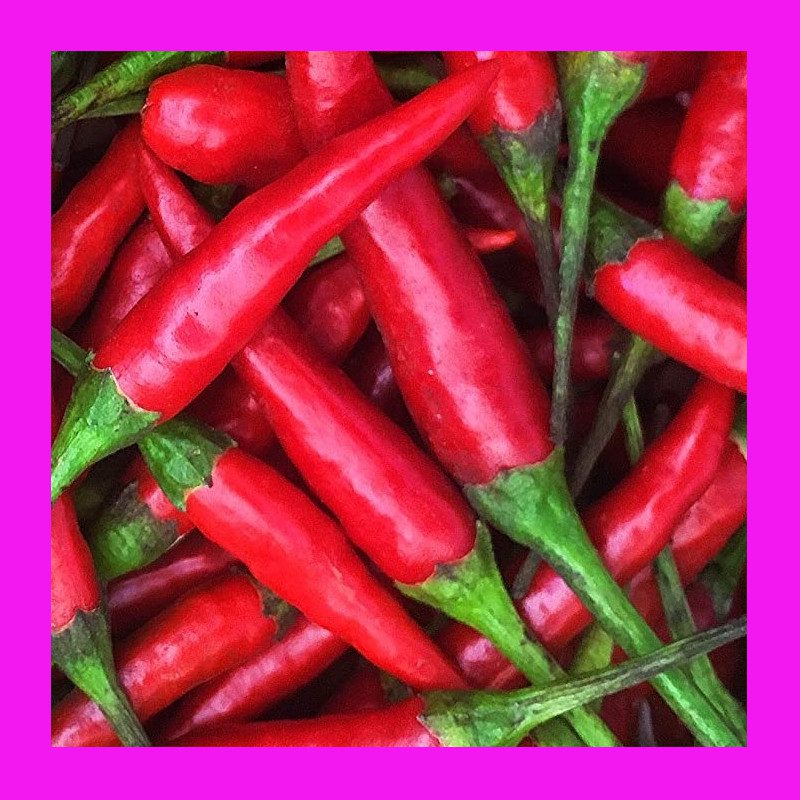
CHILLI-THAI-BIRDS EYE-LARGE
$3.60
Shipping and taxes calculated at checkout
Seeds per pack:
25
Capsicium frutescens
CHILLI-THAI BIRDS EYE-LARGE is also known as Prik Kee Noo (in Thai) and have slightly larger seeds than the smaller cultivar, Capsicum annuum.
In terms of physical characteristics, the Thai Birds Eye Chilli with larger seeds tends to be slightly larger in size, measuring around 2-3 cm in length, and has a thicker skin compared to the smaller-seeded variety. The larger-seeded version also tends to have a slightly milder heat level, ranging from around 30,000 to 50,000 on the Scoville scale, compared to the smaller-seeded variety which is usually hotter, ranging from 50,000 to 100,000 on the Scoville scale.
Both varieties are commonly used in Thai cuisine and are prized for their intense heat and distinctive flavor. The Thai Birds Eye Chilli with larger seeds is often used in dishes such as papaya salad, while the smaller-seeded version is commonly used in curries, soups, and stir-fries.
The Thai Birds Eye Chilli, is red or green in color was used in many traditional herbal remedies in Thailand, that is believed to have various health benefits such as improving digestion and relieving pain.
SKU: CITBE-L
- Fast Australia-wide dispatch
- Secure checkout
- 30-day money-back guarantee
How to Grow CHILLI-THAI-BIRDS EYE-LARGE
To grow Thai Birds Eye-Large chilli seeds you will need to follow these general rules:- Sow the chilli seeds indoors about 6-8 weeks before the last expected frost in your area. Use a seed-starting mix and plant the seeds about 1/4 inch deep.
- Keep the soil moist but not waterlogged. Maintain a temperature of around 25-30°C (77-86°F) until the seeds germinate, which usually takes around 1-2 weeks.
- Once the seedlings have developed their first set of true leaves, transplant them into individual pots filled with a well-draining potting mix.
- Gradually acclimate the plants to outdoor conditions by exposing them to more sunlight and cooler temperatures over the course of a few days.
- Choose a sunny and well-draining location for your chilli plants. The area should receive at least 6-8 hours of direct sunlight per day.
- Prepare the soil outside by adding organic matter such as compost or well-rotted manure to your propagation mix. This will help to improve soil fertility and drainage.
- Plant the chilli seedlings into the prepared soil outdoors once the danger of frost has passed. Ensure soil temperature has warmed up to at least 18°C (65°F).
- Space the plants at least 30-45 cm (12-18 inches) apart to allow for adequate air circulation and prevent diseases.
- Water the plants regularly and deeply, but avoid overwatering as this can lead to root rot. It's also a good idea to mulch around the base of the plants to help conserve moisture.
- Fertilize the chilli plants every 2-3 weeks with a balanced fertilizer that is high in phosphorus and potassium. This will help to promote healthy growth and fruit production.
- Harvest the chillies when they are fully mature and have turned red. Be sure to wear gloves when handling the chillies, as they can cause skin irritation and burning sensations.
Heritage of Thai Birds Eye Chilli
Thai Birds Eye Chilli, also known as Prik Kee Noo (in Thailand), is native to Southeast Asia and commonly used in Thai, Vietnamese, and other Southeast Asian cuisines. It is believed the chilli was introduced to Thailand by Portuguese traders during the 16th century. Now cultivated in many parts of the world and is a popular ingredient in various dishes and sauces. The larger seeded variety of Thai Birds Eye Chilli (Capsicum frutescens) is known for its heat and flavor, making it a staple in many spicy dishes| Scoville Heat Units (SHU) | 30,000 - 50,000 |
|---|---|
| Plant Height | 45 - 75cm (1'6" - 2'6") |
| Season of Interest | Summer / Autumn |
| Temperature Range | 20 - 30°C (68 - 86°F) |
| Annual / Perennial / Biennial | Perenial/Annual |
| Frost Hardy / Tender | Tender |
| Sun Exposure | Full sun |
| Sow Direct / Raise Seedlings | Either |
| Soil Type | Sandy Loam, Rich in nutrients. added compost to the soil for fertility, and dolomite or crushed egg shells to help fend off blossom end rot |
| Soil pH | 5.5 - 7.0 |
| Soil Temperature | 18 - 30°C (64 - 86°F) |
| Seed Preparation | Soak seeds overnight in lukewarm water or freeze for a few days before planting |
| Sowing Depth | 0.5 - 1mm (⅛") |
| Plant Spacing | 30 - 45cm (1⅛" - 1'6") |
| Row Spacing | 45 - 60cm (1'6" - 1'12") |
| Watering | regular, keep moist not wet |
| Germination Time (Days) | 7 - 14 |
| Harvest Time (Days) | 60 - 90 |
| Good Companion Plants | Basil, Cilantro, Coriander, Dill, Marigold, Nasturtium, Onion, Pepper, Tomato |
| Bad Companion Plants | Brassicas, cabbage, broccoli, Cauliflower, etc.), Fennel, Potato |
| Pests | Aphids, Thrips, Whiteflies, Spider Mites |
| Diseases | Bacterial spot, Anthracnose, Phytophthora blight, Verticillium wilt, Root rot, Powdery mildew |
| Not shipped to Tasmania | true |
| Seeds per pack | 25 |
| Min temperature (C) | 20 |
| Max temperature (C) | 30 |

CHILLI-THAI-BIRDS EYE-LARGE
$3.60

More About Direct Compost Solutions
When I started this journey in 2009, I found nothing existed commercially, that was reasonably priced and easy to use. There was a homemade system which I also found was not that user-friendly.
Then a friend of mine told me about a homemade method she used. However, when I tried her method, I found this also didn't suit my needs, as it too had flaws that I considered where important. It did not keep vermin out, did not have a lockable lid and (to me) looked unsightly in the garden.
