

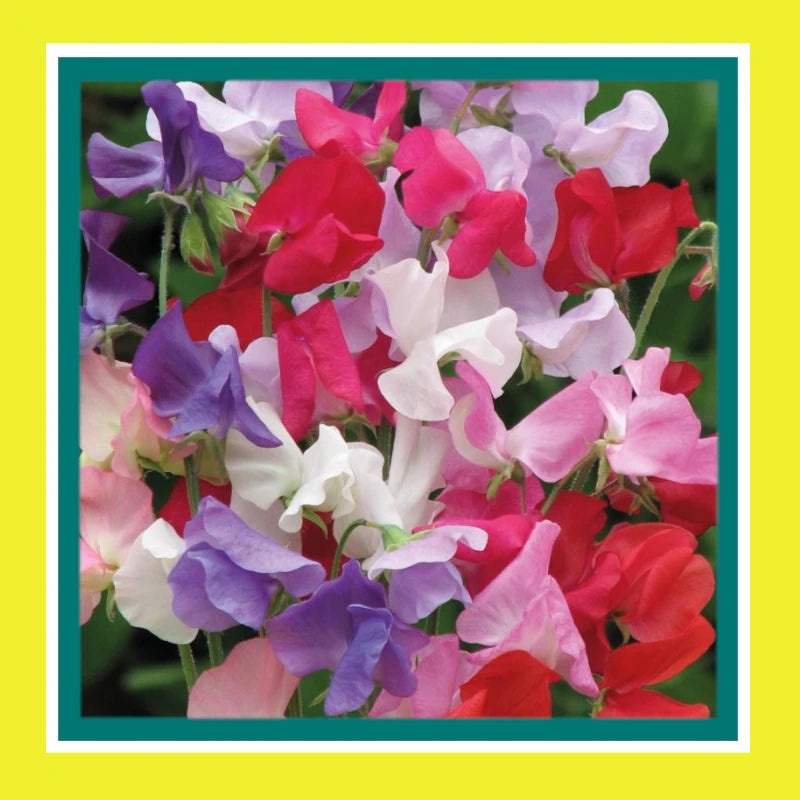
FLOWER-SWEET PEA-MIX (SALE)
$3.50
Shipping and taxes calculated at checkout
Seeds per pack:
54
Lathyrus odoratus
FLOWER-SWEET PEA-MIX (SALE) are beautiful cottage favorites producing large heavily scented flowers in a range of colors. With pink, red, purple, white, and blue hues if makes a great pollinator attracting bees and butterfiles alike. Growing up to 180 cm they are perfect for cut flowers, border planting and container planting. Sweet peas are climbing plants so will need a trellis or support frame.
Considerered a climbing plant they are generall easy to grow so great for educational purpuses to get children growing pretty flowere.
SKU: FLSP-M-1
- Fast Australia-wide dispatch
- Secure checkout
- 30-day money-back guarantee
How to Grow Sweet Pea-Mix
- Choose a location full sun and well-draining soil.
- Sow seeds directly in the garden after the last frost date in your area, or started indoors 6-8 weeks before the last frost date.
- Provide support as they are climbing plants and will need some form of support, such as a trellis, fence, or netting to climb on.
- Regular watering and fertilisation is import to allow your flowers to thrive. Water when the soil is dry to the touch and fertilise every 2-3 weeks with a balanced fertiliser.
- Deadhead by pinching off dead flowers to encourage new blooms and maintain a neat appearance.
Additional growing tips for Sweet Pea-Mix
- Pre-Soak and “Nick” the Seeds for Faster Germination Sweet pea seeds have a tough outer coating. To speed up germination: Nick the seed coat lightly with a nail file or sandpaper to help moisture penetrate. Pre-soak the seeds for 4–6 hours in lukewarm water before planting. For an extra boost, soak them in weak chamomile tea to prevent fungal diseases.
- Use a Toilet Roll Tube or Deep Pot for Stronger Roots Sweet peas develop long taproots, so Instead of standard seed trays, use toilet roll tubes or root trainers (deep containers) to prevent root disturbance. Plant the entire tube into the ground—cardboard decomposes, reducing transplant shock.
- Cold Treatment for Bushier Growth If starting indoors, place seedlings outdoors during the day in cool temperatures (5–10°C / 40–50°F) for a week before transplanting. This hardening off trick strengthens the plants, encourages bushier growth, and prevents legginess.
- The "Pinch and Twin" Method for More Blooms Once seedlings have 2-3 sets of leaves, pinch off the top (just above a leaf node). This forces the plant to grow multiple stems, leading to more flowers later. Twin planting: Instead of one seedling per hole, plant two together for an even fuller effect.
- Companion Plant with Herbs for Pest Control Mint & Basil – Deter aphids naturally. Chamomile – Enhances plant vigor and deters fungal infections. Dill – Attracts beneficial insects like ladybugs that eat aphids.
- Epsom Salt Boost for Greener Leaves If sweet peas look yellowish, add 1 tablespoon of Epsom salt per gallon of water every 4 weeks. This supplies magnesium, making leaves greener and healthier.
- Banana Peel Tea for Extra Blooms Soak banana peels in water for 24 hours. Use this potassium-rich liquid to fertilize sweet peas every 2 weeks—more flowers guaranteed!
- Coffee Grounds for Slow-Release Nitrogen Sprinkle used coffee grounds around the base of the plants to provide slow-release nitrogen and improve soil structure. Great for boosting green, lush foliage.
- Use Mulch to Keep Roots Cool Sweet peas dislike hot roots! Keep the base cool and moist by: Adding a layer of straw, bark, or compost as mulch around the plants. Planting low-growing flowers (like alyssum) at their base for shade.
- Water at the Base, Not Overhead Watering from above increases the risk of powdery mildew. Instead, use a soaker hose or water at the base to keep leaves dry.
- Talk to Your Sweet Peas! It may sound unusual, but studies suggest plants respond to sound vibrations. Some gardeners play soft music or talk to their sweet peas—why not try it and see if it helps?
Heritage of Sweet Pea-Mix
Sweet peas (Lathyrus odoratus) have a long and cherished history. Native to Sicily and southern Italy, they were first recorded in the 17th century by a Sicilian monk, Father Cupani, who described their rich fragrance. By the 19th century, English horticulturist Henry Eckford hybridized sweet peas, developing larger, more colorful blooms. These Victorian-era varieties became immensely popular in English cottage gardens. Today, sweet pea mixes offer a range of colors and fragrances, maintaining their status as beloved heirloom flowers, often associated with nostalgia, romance, and garden elegance.| Plant Height | 60 - 90cm (1'12" - 2'11") |
|---|---|
| Season of Interest | Spring / Summer |
| Temperature Range | 15 - 25°C (59 - 77°F) |
| Annual / Perennial / Biennial | Annual |
| Frost Hardy / Tender | Tender |
| Sun Exposure | Full Sun |
| Sow Direct / Raise Seedlings | Sow Direct / Raise Seedlings / Plant after last frost |
| Soil Type | Well Drained,Fertile Soil |
| Soil pH | 6 - 7.5 |
| Soil Temperature | 10 - 20°C (50 - 68°F) |
| Seed Preparation | Soak seeds overnight in warm water |
| Sowing Depth | 2.5mm (⅛") |
| Plant Spacing | 15 - 20cm (⅝" - ¾") |
| Row Spacing | 45 - 60cm (1'6" - 1'12") |
| Watering | Regular to keep soil moist, not waterlogged |
| Germination Time (Days) | 7 - 21 |
| Harvest Time (Days) | 80 - 100 |
| Good Companion Plants | Lettuce & Spinach, Carrots & Radishes, Nasturtiums, Marigolds, Cucumbers & Squash, Cabbage & Kale, Dill & Basil |
| Bad Companion Plants | Garlic & Onions, Potatoes, Tomatoes & Peppers, Beans, Corn |
| Pests | Aphids, Slugs & Snails, Thrips, Leaf Miners, Spider Mites |
| Diseases | Powdery Mildew, Fusarium Wilt, Root Rot, Botrytis Blight (Gray Mold), Mosaic Virus |
| Not shipped to Tasmania | true |
| Seeds per pack | 54 |
| Min temperature (C) | 15 |
| Max temperature (C) | 25 |

FLOWER-SWEET PEA-MIX (SALE)
$3.50

More About Direct Compost Solutions
When I started this journey in 2009, I found nothing existed commercially, that was reasonably priced and easy to use. There was a homemade system which I also found was not that user-friendly.
Then a friend of mine told me about a homemade method she used. However, when I tried her method, I found this also didn't suit my needs, as it too had flaws that I considered where important. It did not keep vermin out, did not have a lockable lid and (to me) looked unsightly in the garden.
