

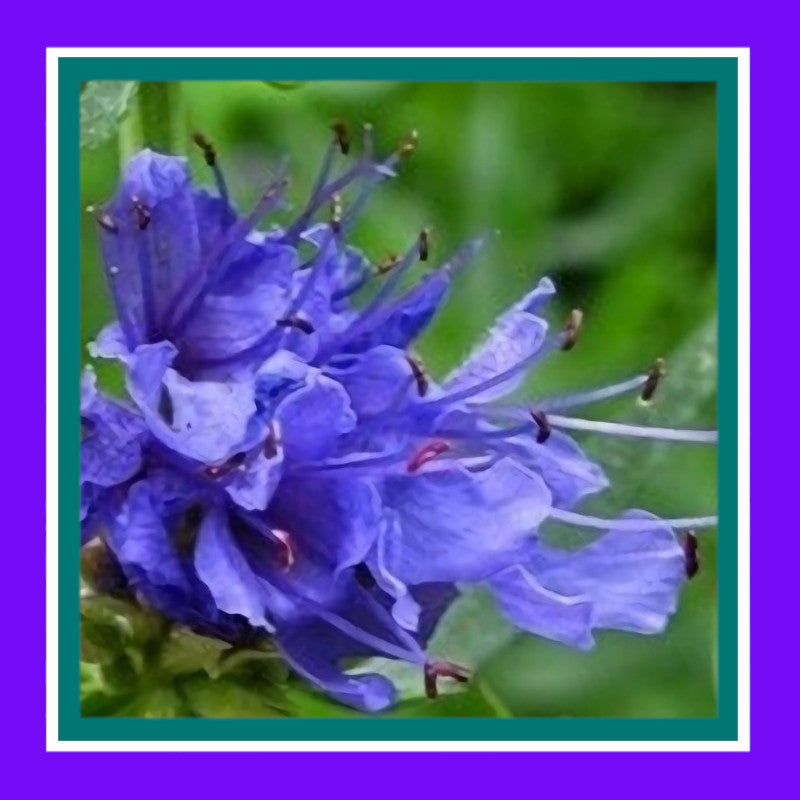
HERB-HYSSOP-BLUE-JUFA (SALE)
$3.50
Shipping and taxes calculated at checkout
Seeds per pack:
540
Hyssopus officinalis
HERB-HYSSOP-BLUE (JUFA) (SALE) an evergreen shrub used as a food & medicinal herb a 30-60cm tall shrub. Stems begin from a single base & are covered in small green scented leaves.
The blue flowers are borne on the top parts of the stem in summer & are harvested & dried. Plants may die back in very cold areas & reshoot in spring. As a herb, the young green stem tips & flowers may be added to cooking or salads.
Hyssop is used for the healing assets of its volatile oils, extract by steeping the dried or fresh green leafy stems in hot water to make a soothing tea. Due to its slight bitter & minty flavour, it is used in soups, salads & meats.
The essential oil of the herb is credited with its astringent, expectorant & anti-inflammatory properties. As a tonic, it is known to lower fevers. A member of the Mint family it attracts bees & butterflies, re-seeds well. In Autumn, new plants can be created by root division.
SKU: HH-B-1
- Fast Australia-wide dispatch
- Secure checkout
- 30-day money-back guarantee
How to Grow Hyssop-Blue (Jufa)
- Blue Hyssop thrives in a sunny location with well-drained soil and at least 6 hours of sunlight per day.
- Sow seeds or transplant seedlings 1/4 inch (0.6 cm) deep into the soil. Maintain a spacing of 12 to 18 inches (30 to 45 cm) between plants.
- Water regularly to maintain soil moisture, especially during the growing season Water deeply when the top 1 inch (2.5 cm) of soil feels dry.
- Temperature Required to grow ideallly will be between 60 to 70°F (15 to 21°C) Protect the plant from frost, as it can be sensitive to cold temperatures.
- Fertilise using a balanced fertiliser with equal parts nitrogen, phosphorus, and potassium Apply the fertilizer every 4 to 6 weeks during the growing season.
- Prun regularly by pinching back the growing tiop to encourage bushier growth
- Harvest the leaves when the plant reaches at least 6 inches (15 cm) in height.
- Keep an eye out for aphids and spider mites. Use neem oil or insecticidal soap for natural pest control.
- Overwinter in colder climates by applying a layer of mulch around the base of the plant to protect it from winter chill. Blue Hyssop is generally hardy, but extra precautions in extreme cold are beneficial. Once Blooming has ceased and the seed capsules are completely dryed, they can be collected and sotred for next seasons growing. In some areas they will readily self-seed.
Heritage of Hyssop-Blue (Jufa)
Blue Hyssop, or Hyssopus officinalis, has a rich heritage dating back to ancient times. It is native to Southern Europe and Western Asia and has been cultivated for its aromatic leaves and vibrant blue flowers. Traditionally, Blue Hyssop has been used for culinary and medicinal purposes, known for its soothing properties and flavorful addition to various dishes. The herb's heritage includes a long history of being valued for its diverse qualities in different cultures and civilizations.
| Plant Height | 45 - 60 cm (1.5 - 2 feet) |
|---|---|
| Season of Interest | Summer |
| Temperature Range | 15 - 25°C (59 - 77°F) |
| Annual / Perennial / Biennial | Perennial |
| Frost Hardy / Tender | Frost Hardy |
| Sun Exposure | Full Sun |
| Sow Direct / Raise Seedlings | Raise seedlings |
| Soil Type | Well-drained loamy or sandy soil |
| Soil pH | 6.0 - 7.5 |
| Soil Temperature | 15 - 22 °C (59 - 72 °F) |
| Seed Preparation | No special preparation needed |
| Sowing Depth | 0.5 cm (0.2 inch) |
| Plant Spacing | 30 cm (12 inches) |
| Row Spacing | 45 cm (18 inches) |
| Watering | Moderate, allow soil to dry between watering |
| Germination Time (Days) | 14 - 21 days |
| Harvest Time (Days) | 80–100 days |
| Good Companion Plants | Lavender, Rosemary, Thyme, Sage, Oregano |
| Bad Companion Plants | Radishes,Carrots, Beans |
| Pests | Aphids, Spider Mites,Whiteflies,Leafhoppers |
| Diseases | Powdery Mildew, Root Rot,Leaf Spot,Rust |
| Not shipped to Tasmania | true |
| Seeds per pack | 540 |
| Min temperature (C) | 15 |
| Max temperature (C) | 25 |

HERB-HYSSOP-BLUE-JUFA (SALE)
$3.50

More About Direct Compost Solutions
When I started this journey in 2009, I found nothing existed commercially, that was reasonably priced and easy to use. There was a homemade system which I also found was not that user-friendly.
Then a friend of mine told me about a homemade method she used. However, when I tried her method, I found this also didn't suit my needs, as it too had flaws that I considered where important. It did not keep vermin out, did not have a lockable lid and (to me) looked unsightly in the garden.
