

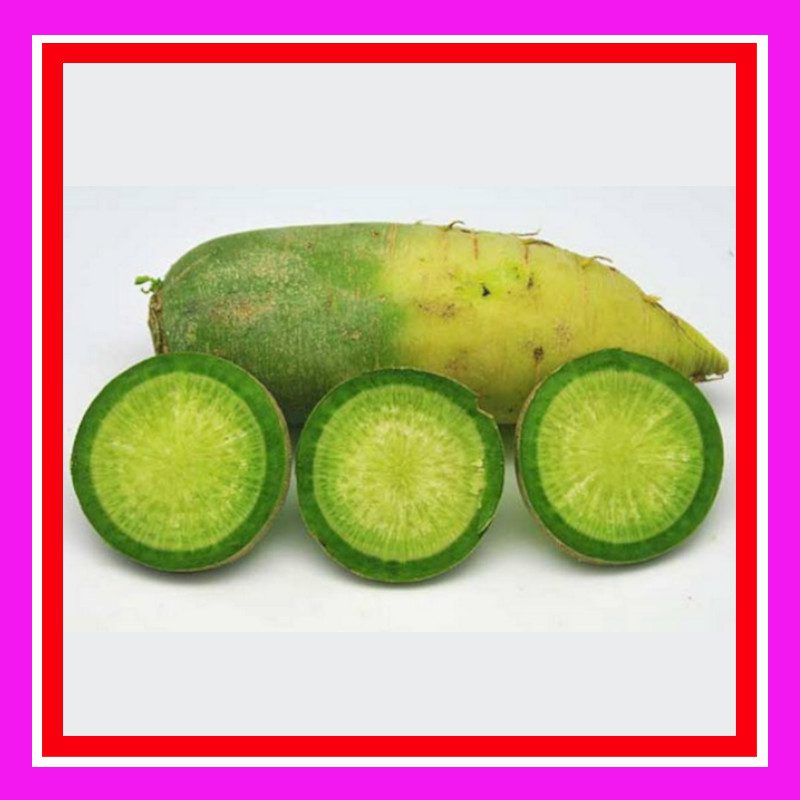
RADISH-ORIENTAL GREEN-QINGLUOBO (TREATED)
$3.50
Shipping and taxes calculated at checkout
Seeds per pack:
30
Raphanus sativus
RADISH-ORIENTAL-GREEN QINGLUOBO (TREATED) is a two toned radish originating from China and commonly recognised for its lime green colour both inside and out. It grows from 12-25cm long and gets hotter as it matures if it is allowed to develop in the sun. For a milder flavour plant in mid Summer or Autumn and harvest in Winter. Can be fermented, grated or sliced and added to salads, stir fry or soup or eaten raw. It tastes a bit like horseradish with a sweet undertone. Grows best in cool climates and can bolt in warmer climates but produces pretty purple flowers.
Any seeds IMPORTED from overseas must be TREATED now according to the new bio-security law. Thus this batch of Qingluobo is treated. If you save the seeds and replant the following year these seeds are considered NOT TREATED.
SKU: ROG-A-T
- Fast Australia-wide dispatch
- Secure checkout
- 30-day money-back guarantee
How to Grow Oriental Green Qingluobo Radish
- Soil Preparation is preferably loose, well-drained soil that is rich in organic matter. Before planting, amend the soil with compost or well-rotted manure to improve its texture and fertility.
- Plant the radish seeds directly into the garden bed in early spring or Autumn, when temperatures are cool. Place the seeds 2-3 cm (0.8-1.2 inches) deep and 5 cm (2 inches) apart, in rows that are spaced 15-20 cm (6-8 inches) apart.
- Water to keep the soil evenly moist throughout the growing season. Water deeply once a week or more frequently during hot, dry weather.
- Fertilising is not required as these radishes are light feeders. However, you can give them a boost by applying a balanced fertiliser (such as 10-10-10) once a month throughout the growing season.
- Thin the radish seedlings after they have emerged. One plant every 10-15 cm (4-6 inches). This will give each radish enough room to grow to its full size.
- Harvesting Oriental Green - Qingluobo radishes can be done in about 30-45 days, depending on the growing conditions. Pull up the radishes when they are about 5-8 cm (2-3 inches) in diameter, before they become tough and woody.
Heritage of Oriental Green Qingluobo Radish
The heritage of Oriental Green Qingluobo radish can be traced back to China, where it has been cultivated for thousands of years. It is believed to have been introduced to the United States in the late 19th century. It is a member of the Brassicaceae family, which also includes cabbage, broccoli, and cauliflower. Unique in size, colour, and flavour, it can be pickled, cooked or eaten raw. The flavour is said to taste like sweet horseradish.*Important Note
These seeds are treated with a fungicide (Thiram), DO NOT eat the seeds or feed them to animals. Keep them away from children & animals. Wear gloves and thoroughly wash your skin with water & soap after touching the seeds. Treated seeds do not affect your crops or harm insects such as bees. These treated seeds are strictly for propagation or growing in the garden only. THE RESULTANT CROP IS EDIBLE. Fungicide seed treatment may be an AQIS (Biosecurity, Department of Agriculture, Water and the Environment, Government of Australia) requirement for certain seed varieties. Treated seeds may be dyed a distinct colour.| Plant Height | 15 - 20cm (⅝" - ¾") |
|---|---|
| Season of Interest | Autumn |
| Temperature Range | 10 - 25°C (50 - 77°F) |
| Annual / Perennial / Biennial | Annual |
| Frost Hardy / Tender | Hardy |
| Sun Exposure | Full Sun / Part Shade |
| Sow Direct / Raise Seedlings | Sow Direct |
| Soil Type | Well-drained soil with plenty of organic matter |
| Soil pH | 6 - 7 |
| Soil Temperature | 7 - 29°C (45 - 84°F) |
| Seed Preparation | Soak seeds in water for a few hours before planting |
| Sowing Depth | 1 |
| Plant Spacing | 2 - 5 |
| Row Spacing | 15 - 30 |
| Watering | Regular watering, keep the soil moist, but not waterlogged |
| Germination Time (Days) | 5 - 7 |
| Harvest Time (Days) | 20 - 30 |
| Good Companion Plants | Cucumber, Lettuce, Spinach, Peas, Beans, Carrots, Brassicas (e.g. cabbage, broccoli, cauliflower) |
| Bad Companion Plants | Mustard plants, Turnips, Radicchio, Potatoes |
| Pests | Flea beetles (Phyllotreta spp.), Root maggots (Delia spp.), Aphids (Aphis spp.), Slugs and snails (Gastropoda) |
| Diseases | Downy mildew, Powdery mildew, Fusarium wilt, Alternaria leaf spot, Clubroot, Root rot, Bacterial leaf spot |
| Not shipped to Tasmania | true |
| Seeds per pack | 30 |
| Min temperature (C) | 10 |
| Max temperature (C) | 25 |

RADISH-ORIENTAL GREEN-QINGLUOBO (TREATED)
$3.50

More About Direct Compost Solutions
When I started this journey in 2009, I found nothing existed commercially, that was reasonably priced and easy to use. There was a homemade system which I also found was not that user-friendly.
Then a friend of mine told me about a homemade method she used. However, when I tried her method, I found this also didn't suit my needs, as it too had flaws that I considered where important. It did not keep vermin out, did not have a lockable lid and (to me) looked unsightly in the garden.
